The Democratisation of Digital Visibility
The Poster Is Easy. Attention Is Expensive.
Yesterday, businesses paid to get noticed. Today, almost anyone can make something worth publishing. Tomorrow, the real contest will be over who earns people's attention.
That is the argument of this piece. Where I quote a number, I name who published it. Where I'm giving my own reading, I say "My view". Where a number comes from a company statement or a report that doesn't explain its method, I say that too.
The Business Next Door Has Gone Digital
A festival greeting from a local shop used to need a designer, a few days and a fee. Or it was a template the shop next door was also using. Today the owner can make one on a phone before lunch and send it to every customer on WhatsApp.
The customers are already there. The Internet in India Report 2025, by IAMAI and Kantar, counts 958 million active internet users, up about 8%. Rural India is over 57% of them (about 548 million), and rural growth is nearly four times the urban pace. The survey covered nearly 100,000 people across 400+ towns and 1,000+ villages.
My view: The shift isn't happening only in a few metros. It's happening in the shop, the clinic, the tuition class, the NGO and the freelancer's profile in every town.
From Printing Presses to Prompt Boxes: The Evolution of the Flyer
The flyer hasn't died. It has moved. The job is the same: here is what we offer, here is the price, here is the number to call. But it now travels as a WhatsApp creative, an Instagram post, a festival greeting or a short video.
A report by Rukam Capital, Beyond Metros (January 2026), says WhatsApp penetration is nearly 90% in Tier II and III markets, and that 32% of non-metro consumers discover products on social media. The survey covered more than 5,000 respondents across 18 states, conducted with YouGov. The published coverage doesn't say when it was run, so treat the figures as indicative.
My view: The printing press made the flyer cheap to copy. The prompt box makes it cheap to create. In both cases, the person with the message gained a way to reach people without asking permission. I wrote about the old version, 500 printed flyers and no money of my own, in I Started a Dance Academy Without Putting In My Own Money.
When Creativity Stopped Being Expensive
Producing a decent-looking creative used to need a designer, software and time. Now it needs a prompt, a phone and a few minutes. The same tools can write the caption, resize it for three platforms and turn it into a short video.
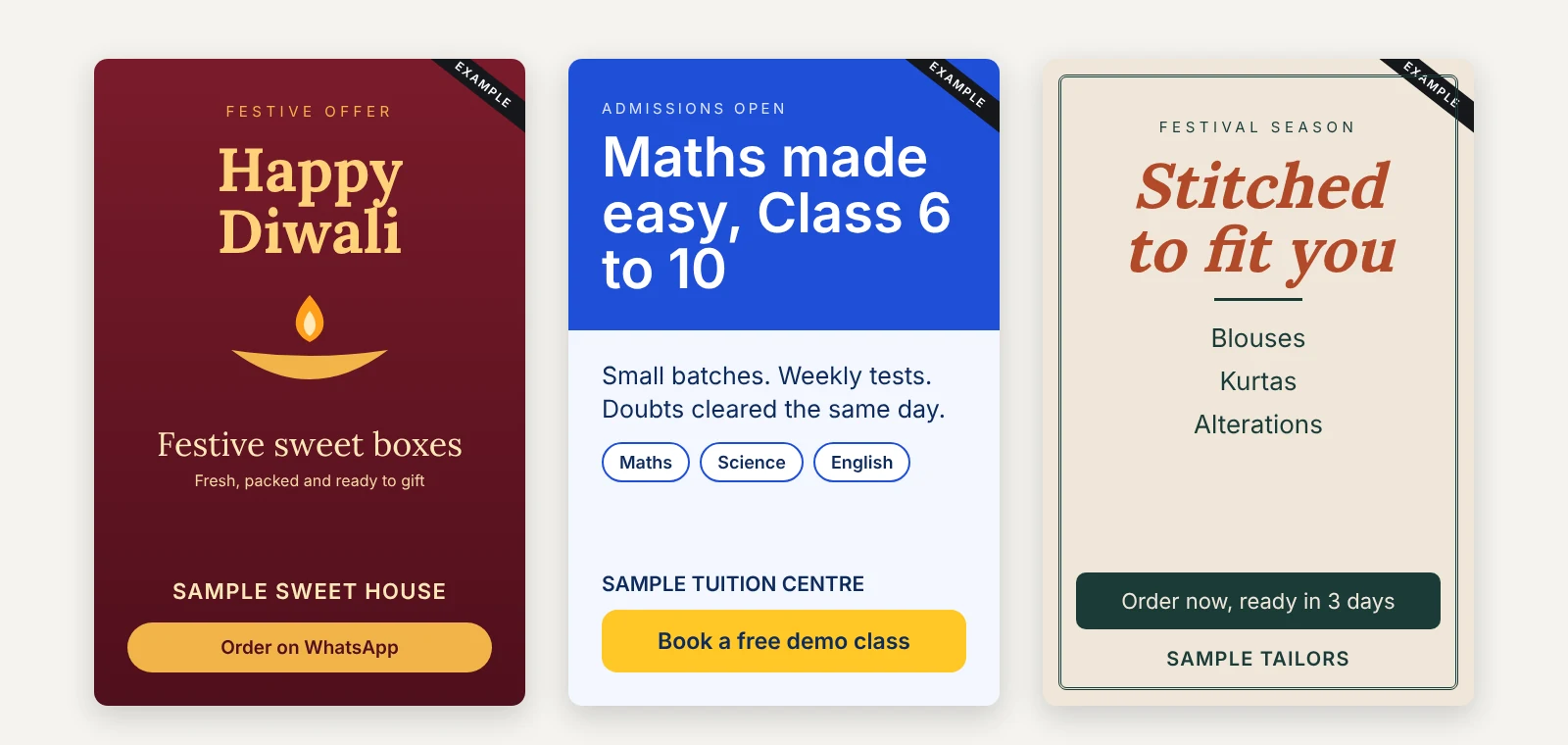
My view: This is what I'd call the rise of the one-person marketing department. A shop owner, freelancer or small NGO can now do the work of a small creative team at a basic level. I'm describing a pattern I see, not citing a study.
I looked for independent data on how much AI has actually cut creative costs for small businesses, and I couldn't find any. What exists is statements from companies. IndiaMART's Dinesh Gulati says AI is "reducing entry barriers to the advertising world". Meta says 92% of businesses using its platforms in India are MSMEs, but that is a company statement with no study behind it.
What is measured is spending. The Pitch Madison report (PMAR 2026) puts MSME digital ad spend at ₹35,814 crore in 2025, up 21%. That tells us small businesses are advertising more. It doesn't prove AI is the reason.
Making Is Cheap. Being Seen Still Isn't.
Think of five steps: make the content, get it in front of people, get them to engage, get them to trust you, and get them to buy. AI has mostly cheapened the first step.
Reach is still bought. The dentsu Digital Advertising Report 2026 says digital advertising grew 19% in 2025 to ₹71,621 crore, which is 59% of all ad spend in India. It expects 70% by 2027, and social media is about 29% of the digital total. Ipsos, writing for ET Brand Equity, gives a lower figure: ₹49,000 crore and 44% of the market for FY2025, which runs from April 2024 to March 2025. The two estimates cover different periods, and they may also define digital advertising differently. Ipsos also reports that FMCG and e-commerce together account for 68% of digital spend, so the biggest budgets sit with the biggest categories.
My view: The old gap was in making, and that has narrowed a lot. The gap in reach has not. A small shop can now make a polished creative, but it still can't outspend a national brand in the same feed. That is why "AI democratises visibility" is only half true. It democratises the ability to make something. Being seen is a separate contest.
The Internet Is Getting Louder. Is Anyone Listening?
If everyone can produce, supply explodes.
Graphite's May 2026 study sampled 55,400 English-language article pages and estimated that about half of new articles are now primarily AI-generated. The share crossed 50% in late 2025 and has stayed near that level since. It covers web articles, not ads or social posts, and it can't detect AI-assisted writing that a human edited. Graphite's authors point to a separate study suggesting AI-written articles largely don't appear in Google or ChatGPT results, but this study did not measure search performance or traffic.
There is some evidence that people notice the sameness. NIQ tested over 2,000 viewers, with brain activity measured for about 150 of them. They found AI-generated ads were rated more annoying, boring and confusing than traditional ones, and produced weaker memory activation. The country isn't stated. Kantar's 2024 survey found 41% of consumers are bothered by AI-generated ads, against 29% of marketers, so marketers may be underestimating the reaction. Kantar also found that AI ads that blend in well did better, with over 40% landing in the top tier for branded cut-through, while obvious AI work lowered branding. None of this is India-specific or about small businesses, so I'd treat it as a signal, not a verdict.
My view: Publishing is not the same as reaching people. When making content costs almost nothing, attention becomes the scarce thing, and scarce things get expensive.
What AI Can't Prove for You: Your Town, Your Voice, Your Word
My view, not data: what AI produces without help is the average. A generic Diwali greeting with a lamp and a glow could be from any shop in any city. What stays hard to copy is what only you know:
- Which street you're on and who your regulars are.
- The language and humour of your town.
- A real photo of your real shop and your real work.
- A promise you keep.
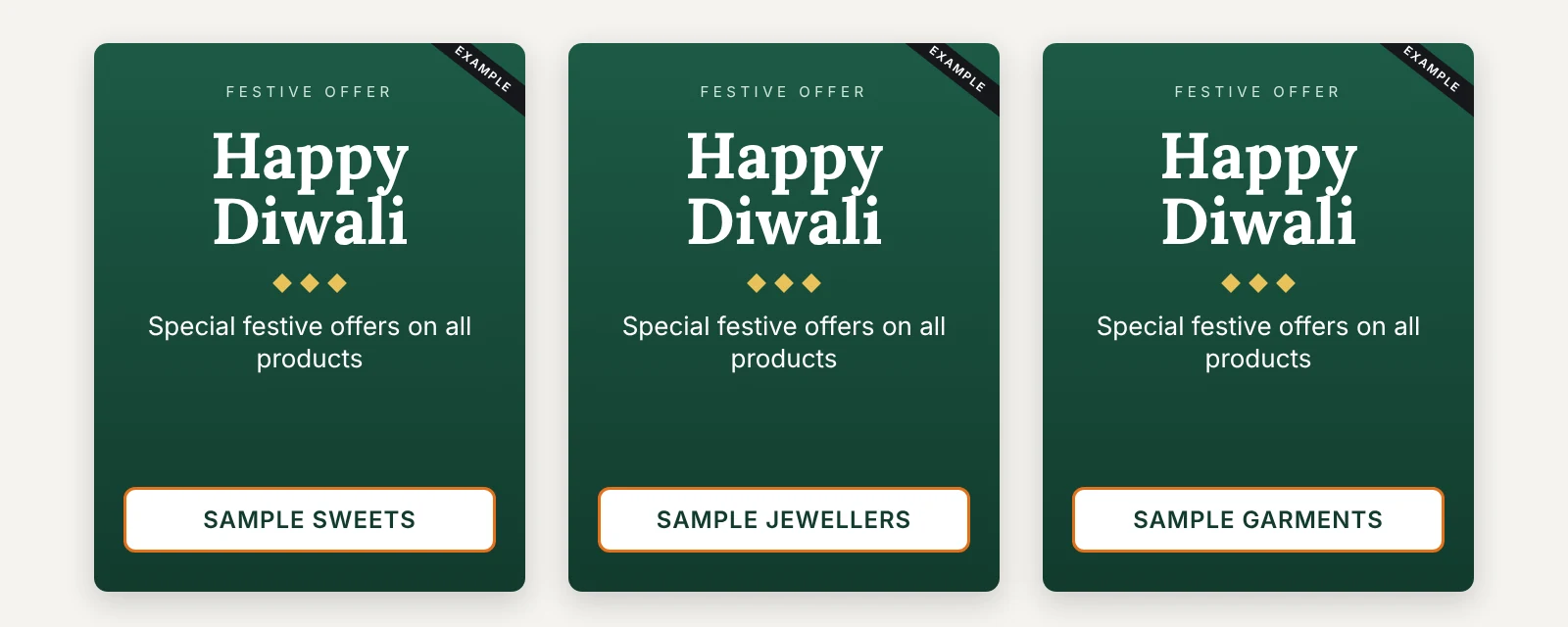
Trust is also earned slowly. The Rukam report says 43% of Tier 3 consumers check brands on official websites, 37% rely on YouTube reviews, and 22% are influenced by word of mouth. Before buying, people look for proof beyond the poster.
This is the same idea as the Friday Test in The Hard-to-Copy Advantage: could a competitor copy this by Friday?
Everyone Can Create. Not Everyone Can Communicate.
Having a tool is not the same as having a message. AI can give a shop owner a good-looking poster in a minute. It can't tell them who the poster is for, why that person should care, where they will see it, or what happens when they reply.
My view, and a prediction, not a finding: as creating gets easier, the advantage moves to the things that were always harder. Distribution, relevance, credibility, and a reason for people to come back. Local owners who use AI for speed and keep the personal parts themselves (the voice, the photos, the follow-up) will do best. Independent professionals will need a clear point of view and proof of past work, because anyone can now look established online. For agencies and designers, routine creative work gets cheaper, and strategy, local insight and taste become what clients pay for.
Before you post, check three things:
- Is it yours? If another shop could post the same thing with its own name, it isn't distinctive yet.
- Is it real? Add something only you have: a face, a place, a price or a result.
- Is the next step clear? Tell people exactly what to do (call, visit, message), and make it one tap.
Yesterday, businesses paid to get noticed. Today, almost anyone can make something worth publishing. Tomorrow, the competition will be over who earns people's attention.
Sources
The figures in this article were checked against the pages below on 8 November 2026. The original IAMAI–Kantar, dentsu, PMAR and Rukam Capital reports were not reviewed, so those figures come from the news coverage linked here. The Gulati quote is from the exchange4media article on PMAR.
- YourStory, IAMAI–Kantar Internet in India Report 2025
- Social Samosa, dentsu Digital Advertising Report 2026, 2 Feb 2026
- Ipsos, The State of Digital Marketing in India 2025-26, 16 Sep 2025
- Exchange4media, MSME digital ad spend (PMAR 2026), 9 Mar 2026
- Social Samosa, Rukam Capital's Beyond Metros, 16 Jan 2026
- Meta, 92% of businesses using Meta platforms in India are MSMEs, 15 Dec 2025
- Graphite, AI-written articles study, 15 May 2026
- NIQ, consumer attitudes toward AI-generated ads, Dec 2024
- Kantar, Rethinking AI-generated advertising, 4 Nov 2025