The Hard-to-Copy Advantage: What Marketing Rewards When Everyone Has the Same AI
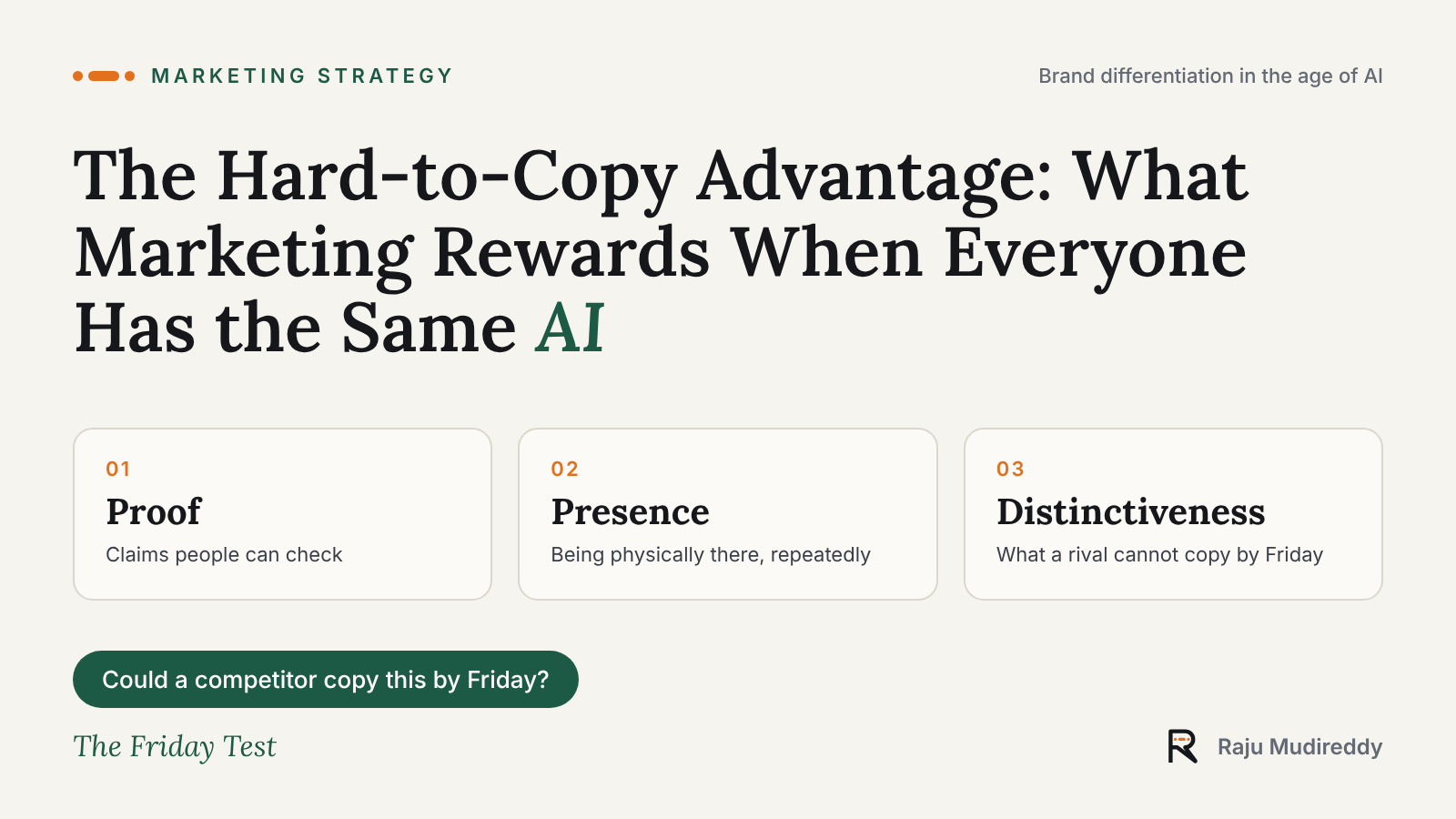
If a competitor gets your AI tools by Monday, what can they not copy by Friday?
Suppose a competitor gets the same AI tools as you by Monday. They buy ads on the same platforms and publish as much as you do. What can they not copy by Friday?
I call that the Friday Test, and I think it is a more useful way to look at the next three to five years of marketing than a list of trends. When anyone can write, design and test at very low cost, a message tells a buyer very little. Advantage moves to what a rival cannot copy quickly.
I see three things that pass the test: proof a customer can check, presence built over time, and a distinctive identity. These are my predictions, built on published research that I have read. I did not conduct the research. I have marked where the evidence is strong, where it is thin, and where it argues against me.
1. Making content gets easy. Choosing what to say gets hard.
Consumers are tiring of AI-generated marketing. In a Gartner survey of 1,006 US consumers, 65% said brands produce too much of it, and 57% said it made them trust brand messaging less. Merriam-Webster chose “slop” as its 2025 word of the year.
Yet AI creative can work. INFORMS reported a Marketing Science study of a live Instagram campaign. An AI-generated image portfolio averaged a 0.98% click-through rate, against 0.65% for a professional designer. In a follow-up 18 months later, the gap was small: 3.38% against 3.24%. It is one company on one platform, and the summary gives no sample sizes.
Both findings can be true. An ad can earn a click without making a brand trusted or memorable, and I found no study that tracks the long-run effect on a brand. So the scarce skill moves upstream: who the brand is for, what it stands for, and what to leave out. When production is cheap, judgment is the expensive part.
2. Discovery splits: fast in B2B software, slower in consumer markets
Pew Research found that 8% of Google visits with an AI summary included a click on a result, against 15% without one. That is a US sample of 900 adults in March 2025, but the direction is clear.
Where buyers go next depends on who they are. In G2’s survey of 1,076 B2B software buyers, 51% said they start with an AI chatbot more often than with Google, and 69% said a chatbot led them to a different vendor than they planned. 80% still use Google somewhere in the journey. G2 sells software reviews, so read this with that in mind. In Gartner’s consumer survey, only 16% of US consumers used chatbots to find new products.
A software company has a reason to check today what AI assistants say about it. A packaged-goods brand still lives in search, social media, marketplaces and shelves. I found no solid India data on discovery through AI assistants, so I would watch it rather than assume it.
My inference, untested: assistants can only describe you accurately if reliable information about you exists in many places. Reviews, press, customers and partners matter as much as your own site.
3. Proof becomes the creative
In a Gartner survey of 1,539 US consumers, 50% preferred brands that avoid GenAI in consumer-facing content, and 68% often wondered whether what they saw was real. In India, Edelman’s 2026 survey of 1,200 people found 89% trust companies headquartered in India, against 74% for foreign companies. Trust is local and relational.
Stated preference is not behaviour, though. An NYU and Emory working paper found fully AI-generated ads got up to 19% higher click-through in field settings. It also found that disclosing AI involvement reduced advertising effectiveness by up to 31.5%. The paper is not yet peer-reviewed. It suggests people react to disclosure more than to the content.
Buyers do not need your content to be AI-free. They need it to be accountable.
So I would avoid the slogan “human-made”. Buyers do not need your content to be AI-free. They need it to be accountable. Name the customer, publish the method, show the workshop, and let someone check. Proof is the one kind of content a rival cannot generate by Friday, because it depends on things that actually happened.
4. Physical presence becomes a costly signal
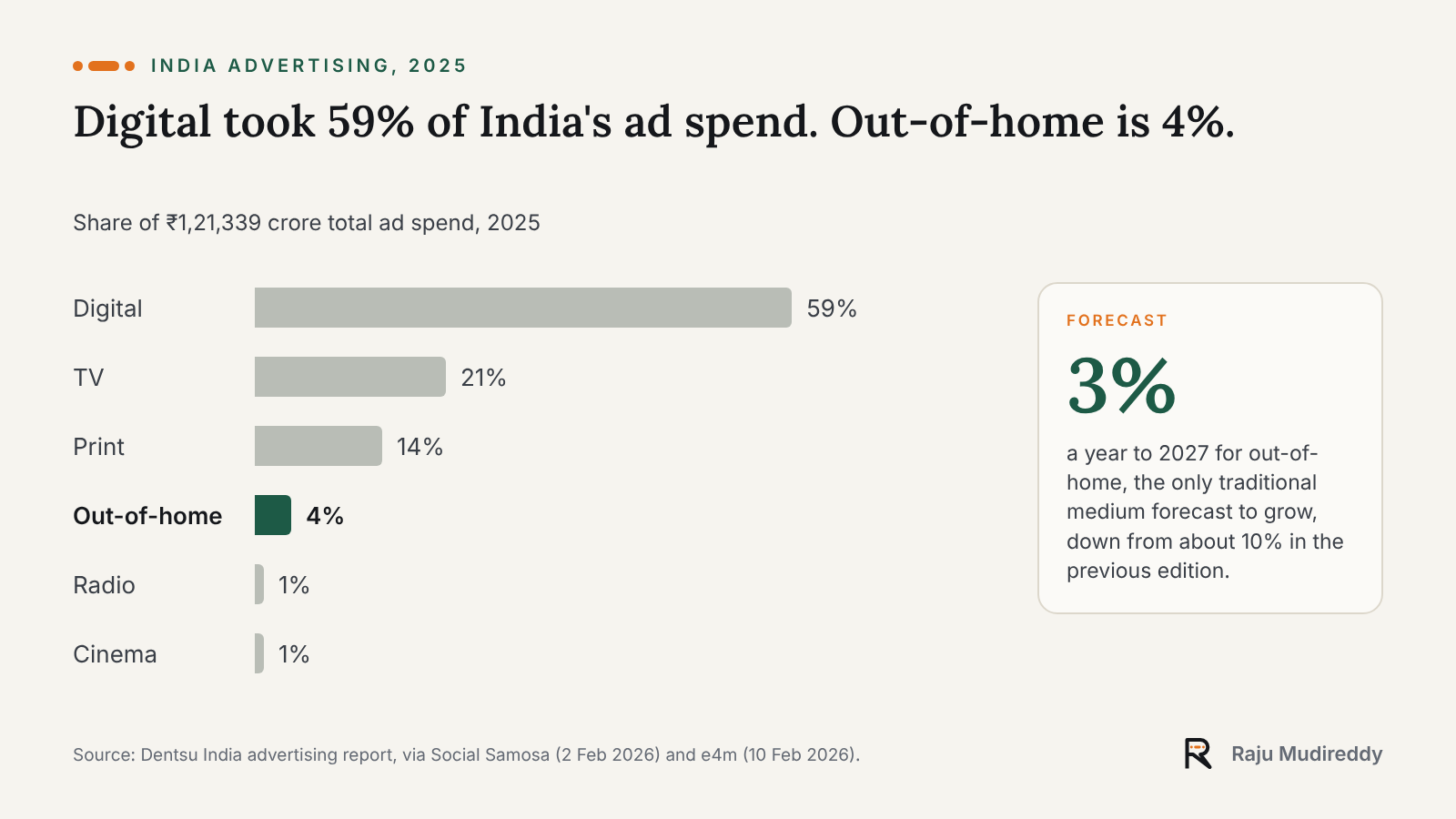
Offline’s case is stronger as a signal than as a channel. According to Dentsu’s 2026 report, out-of-home was ₹4,724 crore in 2025, about 4% of India’s ad spend. It is the only traditional medium forecast to grow, but at 3% a year to 2027, well below the 10% the previous edition projected. Kantar’s Media Reactions 2025, covering 21,000 consumers in 30 markets, puts out-of-home in the top five for both consumers and marketers.
The Maha Kumbh showed the promise and the risk. The official estimate was 66.3 crore visitors. Brands from Dabur and ITC to Bank of Baroda built activations. Before the event, experts predicted ₹1,800–2,000 crore of brand spend. Inventory was quoted at 8–10 times normal local rates, one large FMCG advertiser hesitated, and the ROI case came from the media seller. I found no independent measurement of results.
A quieter example is Hindustan Unilever’s Project Shakti. The company says it has enabled over 2,00,000 women to run rural micro-businesses over two decades. That is a company claim, with no sales share given. But it is presence built slowly, and a rival cannot replicate it with a bigger budget.
Cost is the point. Showing up in person tells people you have committed money, time and people. The same cost means it pays only when it is specific and measured. A forgettable hoarding earns no premium.
5. The funnel becomes a loop, and measurement becomes the discipline
Customers do not see channels. They see a hoarding, search the name, ask a friend, read reviews and buy elsewhere. The IPA’s long-run evidence points to roughly a 62:38 split between brand building and activation. The B2B “95:5” argument says most buyers are not in the market at any moment, so being remembered matters when they are. Its authors work for LinkedIn, which sells ads.
The honest limit: I found no independent study proving that joined-up journeys beat a well-run single channel. The answer is to build your own proof. Use geographic tests, holdout groups, branded-search lift, and one simple question for every new customer: how did you first hear of us?
The Friday Test in practice: a small dance class
Take one activity and ask three questions. Could a rival copy it in a week? Can a customer check what it claims? Would people recognise it as yours without the logo?
In 2017 I started a dance class alongside my job at Deshpande Startups, without putting in any money of my own. I began in borrowed classrooms at ₹150–200 per student a month. Later I moved to a separate classroom at ₹500–800, and printed 500 flyers for ₹200 to reach families door to door. The class averaged around 30 students a month, mostly children under 15, with two dance assistants and paid performances at sangeets and school events. I wrote the full story in I Started a Dance Academy Without Putting In My Own Money.
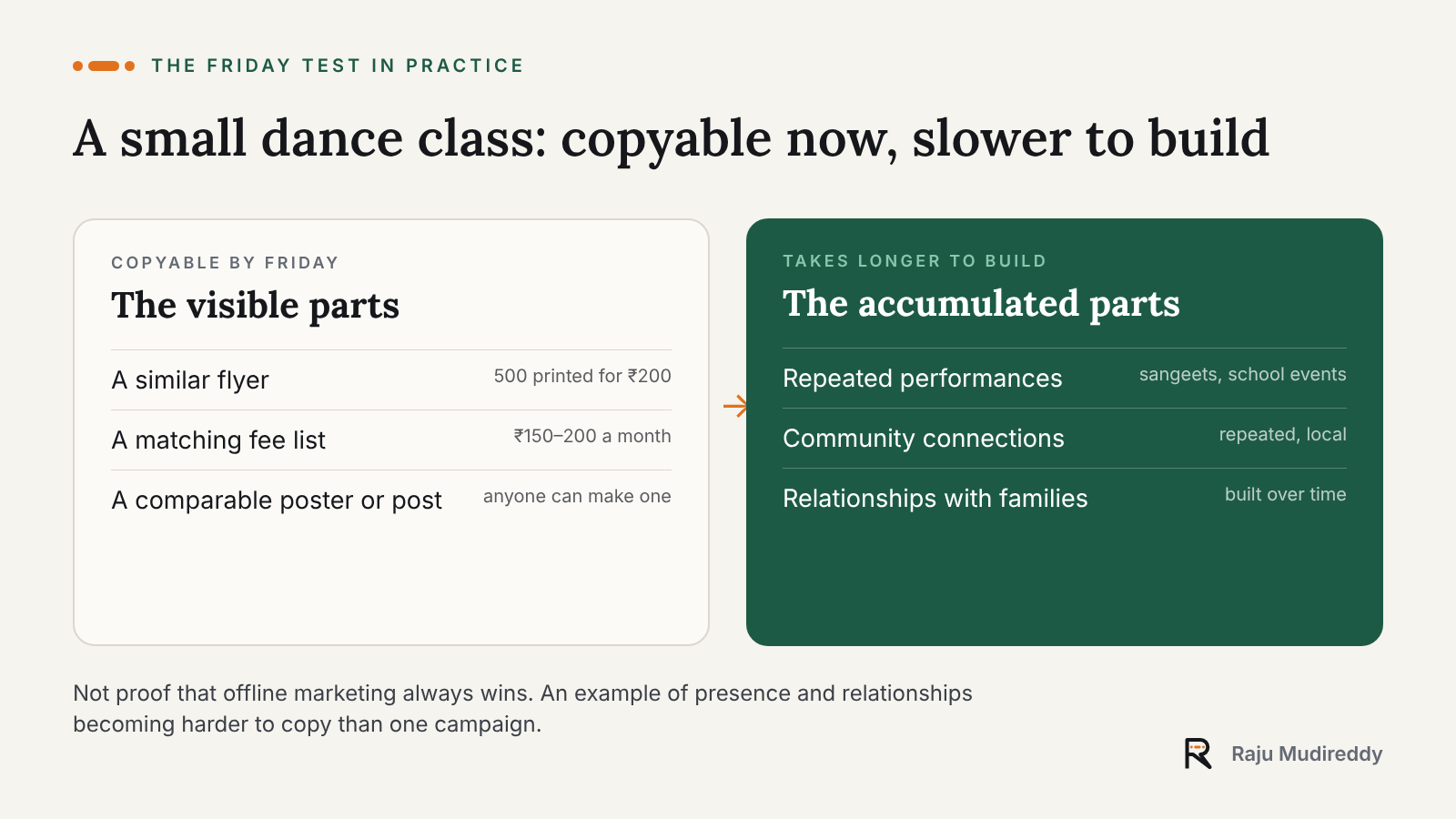
A competitor can copy a fee list or print a similar flyer by Friday. What takes longer to reproduce is the local presence built through repeated performances, community connections, and relationships with families. That is not proof that offline marketing always wins. It is an example of how accumulated presence and relationships can become harder to copy than an individual campaign.
Try it on your own marketing this week. List your last five activities, mark each one that a rival could repeat in a week, and ask which of the rest you can actually prove.
What this means in practice
For business leaders. Fund a few signals that are hard to copy and measure them properly, rather than spreading thinly across ten. Gartner’s CMO survey found only 30% of CMOs report mature AI capability. The tools are shared, but the ability to use them is not.
For marketing teams. Let AI run the production line and keep people on the decisions: positioning, what to claim, what proof to gather. Make proof a routine, with case studies, permissioned customer data and visible processes.
For individual marketers. The evidence that roles are changing is thin, so this is my view. Customer understanding, commercial judgment, relationships and taste are skills a tool does not supply. Show them through work that others can check.
Where I could be wrong
Fake reviews and staged testimonials could scale faster than verification. Consumers may stop penalising AI content. Offline measurement may stay too weak for finance teams to fund. Any of these would shrink the advantage.
Back to the question
When competitors share the same AI tools, content engines and ad platforms, what separates them is what a rival must pay time and money to copy: claims they can prove, presence they have earned, and an identity people recognise. Technology can help build all three, but access to it does not give any brand an edge. Ask the Friday question of next quarter’s budget. What survives it is probably your advantage.
Sources
I opened and read each page below on 24 October 2026. Two original documents were not available to me: the full text of the Marketing Science paper (the figures come from the INFORMS release) and the Dentsu report itself (the figures come from two trade reports that agree with each other). The sample sizes of the Marketing Science study are not published in the release.
- Gartner, marketing survey on AI and consumer trust, 22 Sep 2026
- Gartner, 50% of consumers prefer brands that avoid GenAI content, 16 Mar 2026
- Gartner, consumer survey on GenAI and content quality, 9 Jun 2026
- Gartner, 2026 CMO Spend Survey, 11 May 2026
- INFORMS, release on the Marketing Science study by Daviet and Nishimura, 4 Aug 2026
- Lee, Todri, Adamopoulos and Ghose (NYU, Emory), The Impact of Visual Generative AI on Advertising Effectiveness, SSRN working paper, revised 11 Dec 2025
- Pew Research Center, Google users and AI summaries, 22 Jul 2025
- G2, research on how B2B software buyers use AI chatbots, 2026
- Edelman, 2026 Trust Barometer, India report
- Exchange4media, Dentsu-e4m report on India ad spend, 10 Feb 2026
- Social Samosa, Dentsu report on India ad spend, 2 Feb 2026
- Kantar, Media Reactions 2025, 2 Oct 2025
- Deccan Herald, Maha Kumbh visitor estimate, 6 Mar 2025
- Exchange4media, expected Maha Kumbh brand spend, 13 Jan 2025
- Exchange4media, Maha Kumbh ad rates, 27 Dec 2024
- Hindustan Unilever, Project Shakti, 5 Mar 2026
- IPA, The next chapter for The Long and the Short of It, 13 Sep 2023
- Marketing Week, the 95:5 rule, by Weinberg and Lombardo of the B2B Institute, 2 Sep 2021
- Merriam-Webster, Word of the Year 2025