I Started a Dance Academy Without Putting In My Own Money. Here's How I Found My First Students.
Borrowed classrooms, sponsored speakers, 500 flyers for ₹200, and a business I ran alongside my full-time job.
In 2017, I started DNA Dance Nation Academy while working at Deshpande Startups.
My first classes took place in borrowed classrooms at Deshpande Skilling. I spread the word by talking to students, and the classes filled up.
A couple of months later, I moved into a separate classroom. This time, I had to reach families who didn't already know me.
I designed my own marketing materials, printed 500 flyers for ₹200, and distributed them door to door. In the first 15 days, I had two students.
Here's how I built the academy using my skills, time, relationships, and the resources available to me.
Chapter 1: Filling a classroom through conversations
DNA stands for Dance Nation Academy. Friends at the incubator helped me think about the name.
I didn't rent a studio to get started. Deshpande Skilling had classrooms sitting unused in the evenings, so I approached the heads of the departments and asked if I could use them. They approved my request.
I offered dance classes at ₹150–₹200 per student per month.
I started gathering students from different programs and promoting the classes myself. There were no posters or flyers at this stage. I relied on conversations and direct outreach.
My teaching setup was basic: a mobile phone and a small speaker.
Because I had access to classrooms without paying rent, I could start without spending my own money on a separate space or a full studio setup. The classes ran that way for a couple of months.
Chapter 2: Finding a classroom of my own
Eventually, I wanted DNA to operate as a separate dance class.
I needed a suitable room, preferably one that already had mirrors installed. I found a personality training institute run by Prashant Motagi. The institute held its sessions during the day, leaving the classroom available afterwards.
I approached Prashant and asked whether I could use the room after his sessions. He agreed.
That solved one problem. I had access to a space suitable for dance without having to set up an entirely new studio.
I still needed speakers.
At Deshpande Startups, our CEO at the time, C. M. Patil, encouraged employees to explore entrepreneurship and build things of their own. I prepared a short presentation explaining DNA Dance Nation Academy and what I wanted to build.
He sponsored the speakers.
 (open full-size image)
Moving into a separate classroom also changed the economics of the business.
At Deshpande Skilling, I charged ₹150–₹200 per student per month. In my own classroom, the fee increased to ₹500–₹800 per student per month. I now had an initial advance and recurring rent to cover.
I started collecting fees in advance, which helped me cover the upfront costs of the room.
Chapter 3: 500 flyers for ₹200
At college, students were already gathered in one place. In the neighbourhood around my new classroom, I had to go out and find families.
I decided to handle the marketing myself.
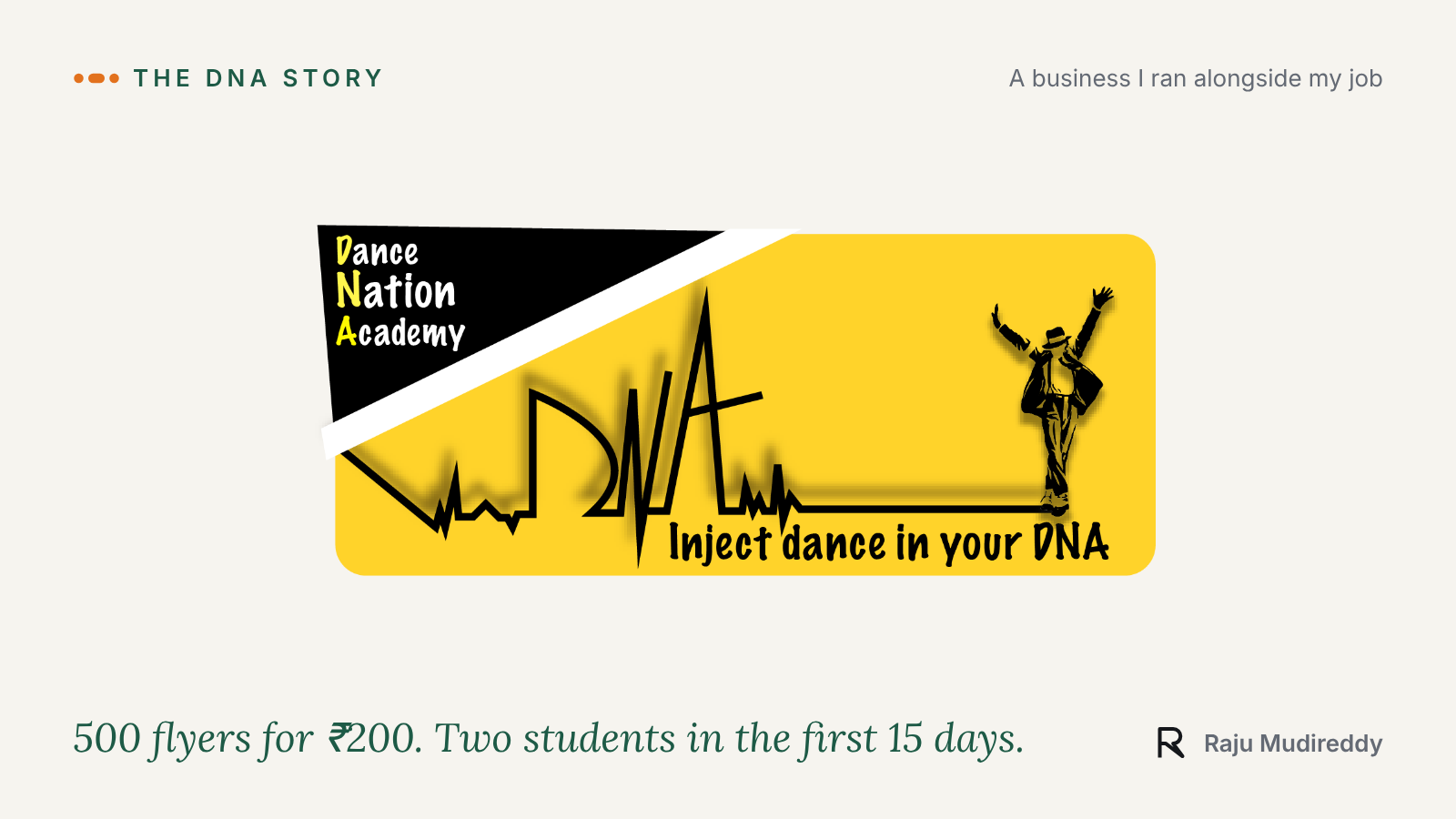
I designed the DNA logo, created the posters and flyers, and managed the social media pages. The flyer was open to both children and adults and included an early-bird discount for registrations.
Then came printing.
Rather than outsourcing the entire job to a print shop, I worked out a cheaper way to do it. I fitted four flyers onto each A4 sheet and used the office printer, paying for what I used.
500 flyers for ₹200. That's 40 paise per flyer.
I covered the printing cost using an advance payment from a student rather than my personal funds.
I designed the material, printed it, cut it, and distributed it door to door. Design and distribution didn't require additional cash payments because I did the work myself, although they took my time.
 (open full-size image)
I didn't have a marketing budget to outsource everything. I used the skills and resources available to me to get the offer in front of potential customers.
But keeping printing costs low didn't guarantee registrations. I still had to find customers and earn their trust.
Chapter 4: Two students in the first 15 days
My first 15 days at the new class brought two children.
Just two.
I had designed the flyers, distributed them around the neighbourhood, and managed the social media pages. Getting the message out didn't immediately translate into a large number of registrations.
I continued teaching those first students and working to build the class. I collected fees in advance, which helped me manage the initial costs of the room.
My main focus was children under 15, with batches divided by age, although I taught others too. My previous experience teaching children helped me connect with them, and parents could see how I spoke to and treated their children.
I knew that attracting children's interest was only part of the job. Parents also had to feel comfortable with the person teaching their children.
Then word of mouth started working.
The parents of those first children told other parents. After the first 15 days, another ten students joined. That was enough to cover the rent.
Over the following months, the numbers continued to grow, and I averaged around 30 students a month.
 (open full-size image)
 (open full-size image)
The flyers helped families discover the class. The relationships I built with students and parents helped word of mouth spread.
Chapter 5: Beyond the regular classes
DNA wasn't limited to monthly dance classes.
I also took my dancing outside the classroom through performances, sangeets, and school events. I was paid for sangeet choreography and for group choreography involving my students at events.
This brought in income beyond the monthly fees and gave my students opportunities to perform on stage.
As the classes grew, I hired two dance assistants in phases and paid them from the class's income.
Building a business alongside my job
I worked at the office during the day and taught dance in the evenings. For a long time, I handled the branding, marketing, conversations with parents, and teaching myself.
I ran DNA Dance Nation Academy for a couple of years before eventually deciding to stop it.
It was a small business, but it involved real customers, pricing decisions, rent, marketing, performances, and managing a team—all alongside a full-time job.
I didn't eliminate every expense. Once I moved into a separate classroom, rent became a real operating cost. What I kept small was the amount of my own money I needed to get started.
I used my dance skills, time, relationships, and available resources to build something people were willing to pay for.
DNA gave me hands-on experience in branding, customer acquisition, relationship-building, and running an operation. I learned by building something myself, working with real customers and solving problems as they came up.