Before You Buy More Leads, Find Where Customers Are Leaving
A business owner says: "We need more leads."
Maybe.
But before spending another ₹10,000 on ads, I'd check something simpler: where are the current customers dropping off?
"More leads" is the most common answer to slow sales because it's the easiest one to act on. You can buy ads today. You can boost a post in five minutes. It feels like progress.
But if people are already finding you and leaving, more leads just means more people leaving. You pay to fill a bucket that has a hole in it.
Four places customers leave
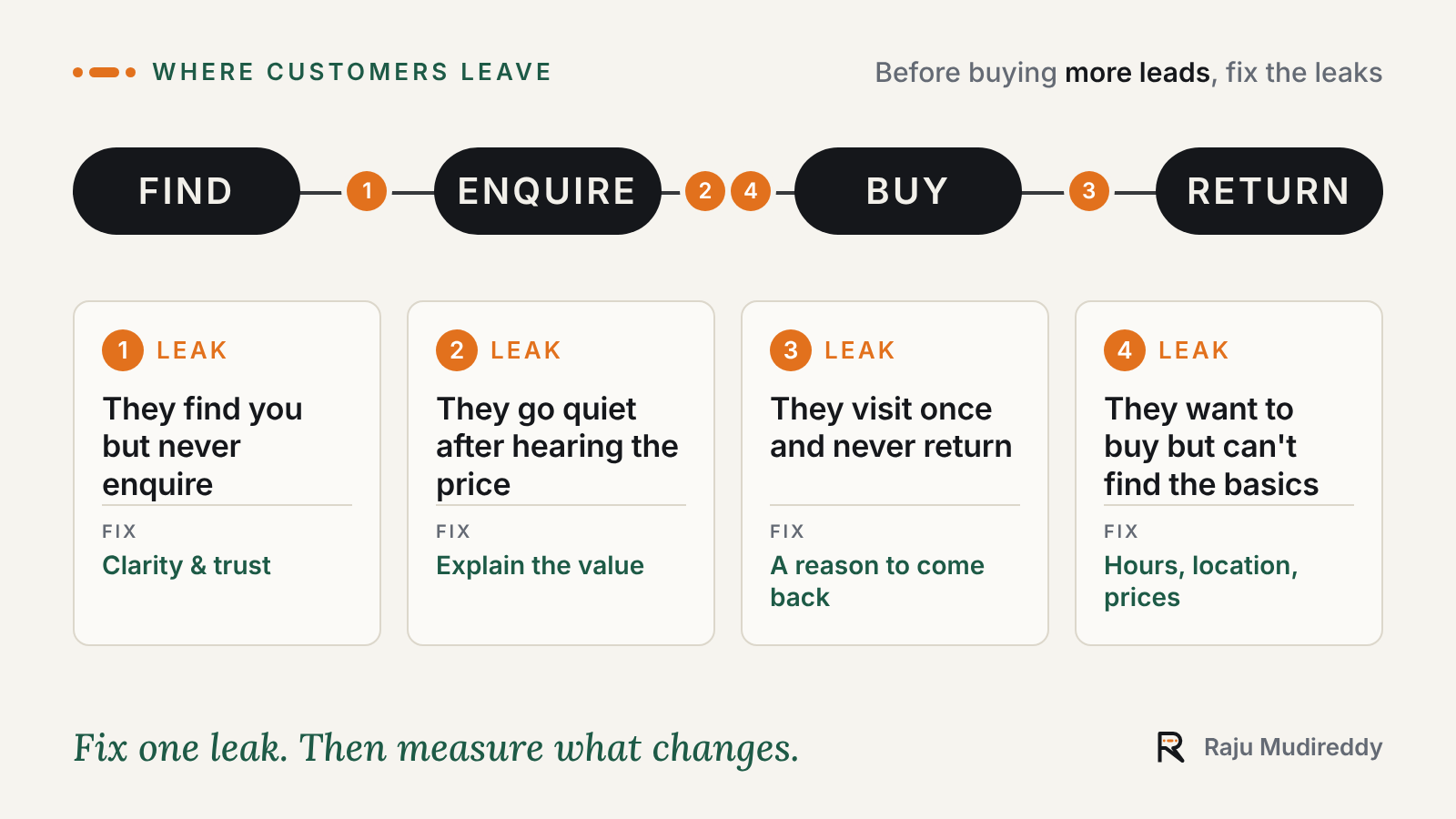
Every business has a path a customer walks: they find you, they get in touch, they decide to buy, and — ideally — they come back. People can leave at any step, and each exit point tells you something different.
 (open full-size image)
1. They find you but never enquire
People see your listing, your page or your shop — and don't take the next step.
This usually isn't a reach problem. It's a clarity or trust problem. Common causes:
- It isn't obvious what you offer or who it's for.
- There are few reviews, or the recent ones are bad.
- Photos are missing, old or unclear.
- There's no easy way to get in touch.
What to check: Look at your Google Business Profile, website or Instagram as if you were a stranger. In ten seconds, would you know what this business does, why it's worth trusting and how to contact it?
2. They enquire but disappear after hearing the price
They were interested enough to ask. Then the price came up, and they went quiet.
This is often a value problem, not a price problem. The customer heard a number without understanding what it includes or why it's worth it. Sometimes it's a fit problem: your marketing attracted people looking for something cheaper than what you sell.
What to check: How is the price shared? A bare number on WhatsApp lands very differently from a short explanation of what's included. Are you following up, or does every quiet enquiry just disappear?
3. They visit once but never return
The first sale happened — and that was it.
This points to the experience or to the lack of a reason to return. Either something about the visit disappointed them, or nothing gave them a reason to come back.
What to check: Ask a few one-time customers what they thought. Look at your reviews for repeated complaints. Ask yourself whether you do anything after the first purchase — a follow-up, a reminder, an offer for the next visit.
4. They want to buy but can't find basic information
This is the most frustrating loss because the customer was ready.
Opening hours are wrong. The location pin is off. There's no price range. The phone isn't answered. The menu, catalogue or service list is missing. Each of these is small. Each one is enough to send a ready customer to a competitor.
What to check: Try to buy from yourself. Search for your business, find your hours, locate your shop, try to place an order or book an appointment. Note every point where you had to guess.
 (open full-size animated diagram)
Four problems need four different solutions
These are four different problems. They shouldn't get the same marketing solution.
- More leads won't fix a confusing offer. If people don't understand what you sell, more of them won't understand it either.
- More reach won't fix a slow response. If enquiries wait hours for a reply, more enquiries just means more waiting.
- More ads won't fix a trust problem. If your reviews or profile make people hesitate, ads send more people to that hesitation.
Ads amplify whatever happens next. If what happens next is broken, ads amplify the break.
How to find the biggest point of friction
You don't need expensive tools. For two to four weeks, keep a simple count of how many people:
- Found you — profile views, calls, website visits, walk-ins.
- Enquired — messages, calls, form submissions.
- Heard a price or quote.
- Bought.
- Came back.
A notebook or a basic spreadsheet is enough. Then look at where the biggest drop happens between two steps. That's where to start.
 (open full-size image)
Numbers show you where people leave. To understand why, talk to them. Message a few people who enquired but didn't buy. Most won't reply. The few who do will often tell you exactly what went wrong.
Fix one thing, then measure
Once you've found the biggest drop, resist fixing everything at once.
Fix one thing. Then measure what changes.
If replies to enquiries are slow, set a response-time target and track whether more enquiries turn into sales. If prices are confusing, send a short explanation with every quote and compare the results to before.
Fixing one thing at a time matters because it tells you what worked. Change five things in the same month and you'll never know which one made the difference — or whether one of them made things worse.
When more leads really is the answer
Sometimes the owner is right. If people find you, enquire, buy and come back at a healthy rate, and the only problem is that not enough people are entering at the top, then more reach is the right investment.
The point isn't that lead generation is wrong. It's that it should be a decision, not a reflex.
The first task
My first marketing task wouldn't be "get more traffic."
It would be: find the biggest point of friction, fix one thing, and measure what changes.
It's less exciting than launching a campaign. It's also cheaper — and it makes every rupee you spend on ads afterwards work harder.
If you could inspect only one stage of a business's customer journey, which would you choose?