Your Customers Are Already Writing Your Marketing Plan
Most small businesses decide their marketing the same way. They look at what a competitor is doing, pick a discount or a platform that feels right, and spend money hoping it works.
Meanwhile, their customers have already written down — in public, in their own words — what they like, what annoys them, and why they came back. It's sitting in Google reviews, on food-delivery apps, in WhatsApp messages and in feedback forms.
That's not just reputation data. It's free market research. And most owners read it only to reply "Thank you!" or to defend themselves against a one-star rating.
This article is about reading it differently: as the starting point for your marketing.
Why reviews are better research than you think
A review is one of the few pieces of customer feedback you didn't prompt. Nobody handed the customer a questionnaire with your preferred options. They chose what to mention.
That makes reviews useful in three ways:
- They show what customers notice. If 15 people mention how fast the food arrived and nobody mentions your interiors, that tells you what is actually memorable.
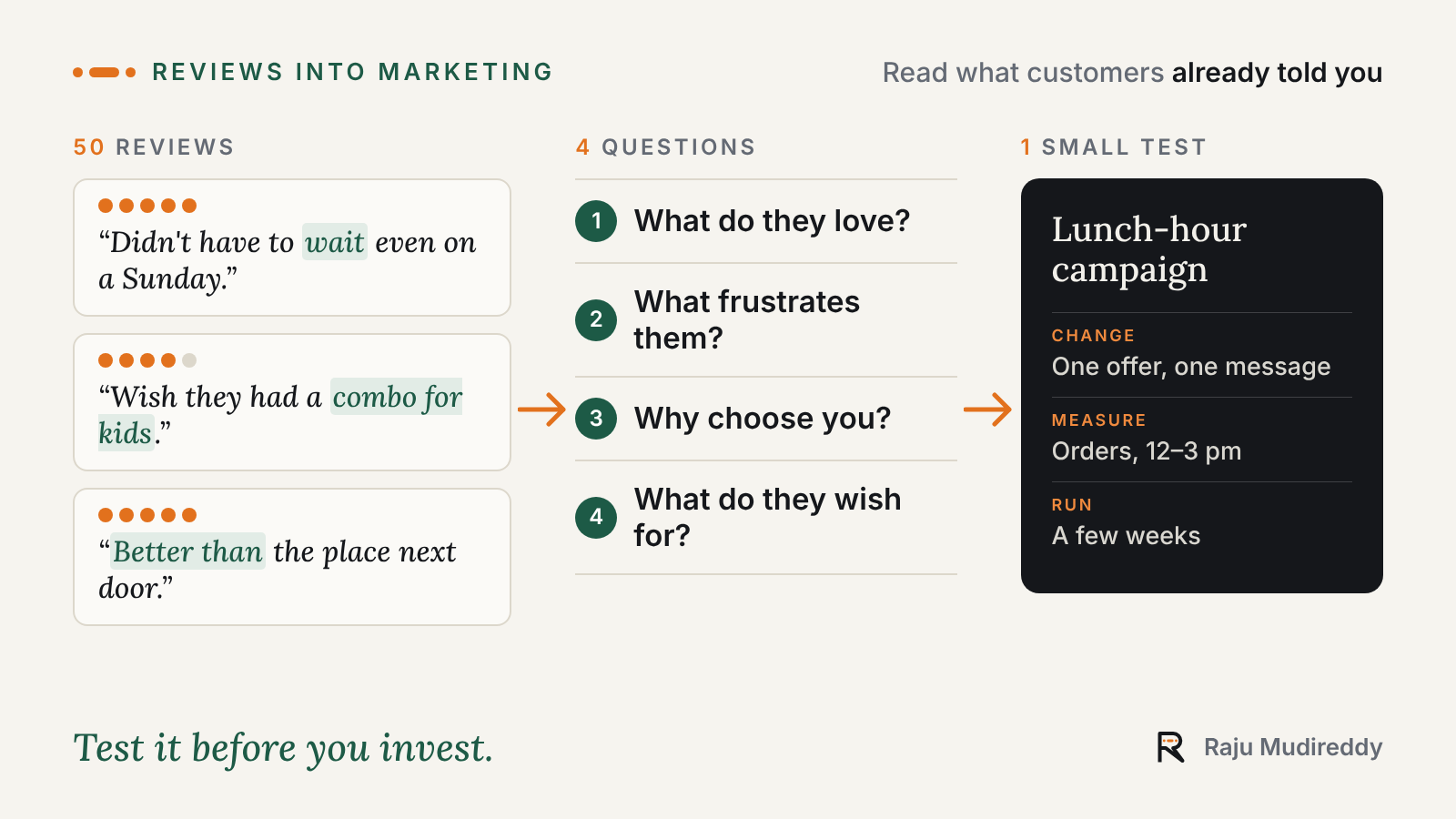
- They use customer language. "Didn't have to wait even on a Sunday" is better ad copy than anything a business usually writes about itself.
- They often include comparisons. "Better than the place next door" or "cheaper than most cafés here" tells you how customers place you in their own mind.
One review is an opinion. Fifty reviews start to show a pattern.
Four questions to ask your reviews
Take a restaurant as the example. Collect around 50 recent reviews — positive and negative — and look for answers to four questions.
1. What do customers love most?
This is your real strength, which is not always the one you'd list yourself. An owner may believe the restaurant is known for its biryani, while reviews keep praising the service or the portion size. Your marketing should lead with what customers already value.
2. What frustrates them?
Repeated complaints are a warning before they are a marketing opportunity. If many people mention long waiting times or cold deliveries, advertising will bring more people into the same disappointment. Some problems need to be fixed before they are promoted around.
3. Why do they choose you over competitors?
Look for words like better, only place, compared to, or instead of. These reveal your positioning — the reason you win — in the customer's terms, not yours.
4. What do they wish you offered?
"Wish they had a combo for kids." "Would love a smaller portion option." Requests like these are product and marketing ideas handed to you for free.
Where AI fits in — and where it doesn't
Reading 50 reviews and grouping them by theme takes time. This is a place where an AI tool is useful.
Copy the reviews into a tool like ChatGPT, Claude or Gemini and ask something like:
Here are 50 customer reviews of my restaurant. Group them into themes. For each theme, tell me how many reviews mention it and quote two or three examples. Then answer: What do customers love most? What frustrates them? Why do they choose us over competitors? What do they wish we offered?
 (open full-size image)
Asking for counts and quotes matters. It keeps the tool tied to what customers actually said, and lets you check the patterns yourself instead of trusting a neat summary.
But keep two limits in mind:
- Reviews are not all your customers. People who write reviews tend to be very happy or very unhappy. The quiet majority is missing.
- AI can overstate patterns. A theme mentioned three times can sound like a major trend in a confident summary.
So treat what you find as a hypothesis, not a conclusion. Before investing, check it with real customers: ask a few regulars at the counter, run a two-question WhatsApp poll, or listen to what your staff hear every day.
 (open full-size animated diagram)
Turn insights into small experiments
An insight is only useful if it changes what you do. The simplest bridge is a small, cheap test.
Here's how two insights from reviews could turn into marketing experiments:
If customers repeatedly praise your quick service, test a lunch-hour campaign aimed at office-goers who have limited time. Your message writes itself: fast, reliable, back to work on time.
If customers keep asking for affordable family meals, test a family combo and promote it to the people who mentioned it — families on weekends.
 (open full-size image)
For each experiment, decide three things before you start:
- What are you changing? One offer, one message or one channel — not everything at once.
- What will you measure? For the lunch campaign, it might be orders between 12 and 3 pm. For the family combo, it might be how many combos sell each weekend.
- For how long? Long enough to see a difference — a few weeks — and short enough that a failed test doesn't cost much.
If the test works, invest more. If it doesn't, you've learned something cheaply, and you still have 49 other reviews' worth of ideas.
It isn't only for restaurants
The restaurant is just an easy example. The same approach works for any business that has customers talking about it:
- A salon might find that customers value punctuality more than the latest styles.
- A coaching centre might discover that parents talk more about personal attention than results.
- A local shop might learn that home delivery is the reason people stay loyal.
In each case, the marketing message is already in the reviews. The business just hasn't read them that way yet.
The point
Marketing often starts with the question, "How do we get people's attention?" A better first question is, "What are our customers already telling us?"
Your reviews won't give you a complete strategy. But they will tell you what to say, who to say it to, and what to fix before you say anything at all.
Stop guessing what your customers want. Start with what they've already told you — then test it before you invest.
What's the first thing you'd look for in your customer reviews?